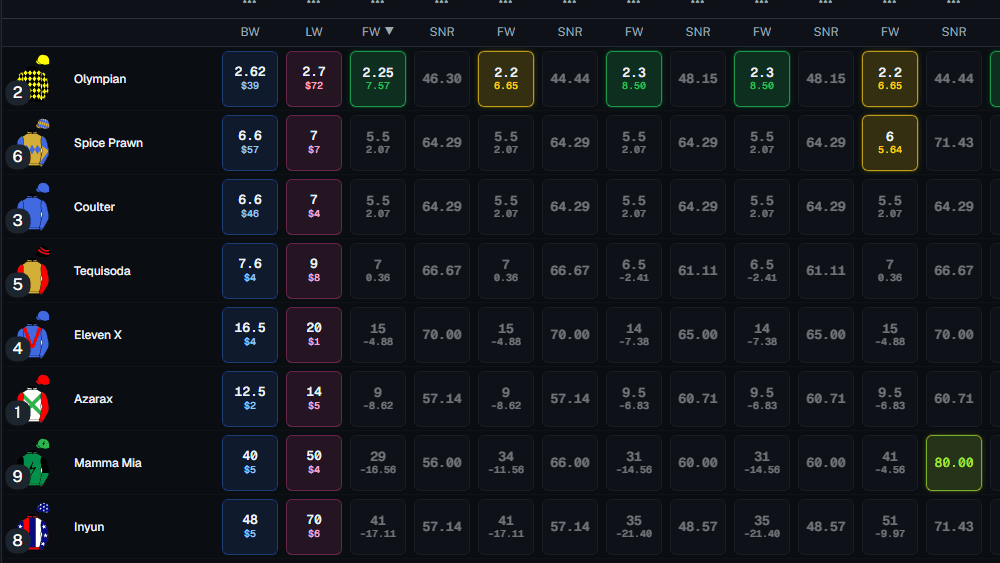
Every odds-comparison tool sells you the same line: "We show you the best price." What they don't tell you is what they measure value against. When a grid hands you a single "fair odds" reference, it's almost always the Betfair lay price.
That's fine if you're a layer. If you're not, it's a conservative anchor that quietly costs you bets. The lay price assumes someone wants to back the runner at that exact tick. In low liquidity — the reality for any Australian race ten minutes out from the jump — that price can sit stale, drift on thin air, or bounce on a single $20 bet. You end up measuring value against a number that may not reflect any real market consensus at all.
You know better than that.
A fair price isn't a single tick on an exchange. It's a read — the weighted consensus of the sources you trust, stripped of margin, tuned to how you see the market.
That's exactly what EVSTREAM's Blended Fair Price column does. You pick the sources. You weight them. You name the column. And once it's live, every EV metric on your grid — QL%, SNR, FW and the rest — is calculated against your benchmark instead of someone else's default lay price.
The Problem With One-Size-Fits-All "Fair" Odds
Most grids hand you a single reference price and call it fair. Almost always that's the Betfair lay. The logic is simple — if you can lay it there, it's a ceiling on true probability — but it breaks down fast.
Too conservative for non-layers. If you're backing, not laying, the lay price builds in a spread you never asked for. Value that looks marginal against the lay can be clearly positive against the back, the mid, or a de-vigged corporate line. You pass on bets you should take.
Unreliable in low liquidity. Ten minutes out from a provincial Wednesday, the lay might be one stale order from a hobby punter. A single small bet moves it twenty ticks. You're not reading the market — you're reading noise.
Raw bookie prices still include the overround. Even tools that look at the corporates often compare raw prices, margin and all. Comparing a boosted Neds price to a raw TAB fixed price isn't a fair fight — you're comparing padded numbers and hoping the gap is big enough.
The Blended Fair Price column fixes all three in about thirty seconds.
How to Build Your Consensus Column
The whole thing lives in one panel: one weighted, de-vigged consensus column per market. Here's the flow.
1. Pick your sources (2–5). Choose from the major corporates — TAB, Sportsbet, PointsBet, Neds — plus three cuts of the Betfair exchange:
| Betfair cut | What it gives you |
|---|---|
| Back (BW) | The exchange back price. |
| Lay (LW) | The exchange lay price — the conservative anchor most tools default to. |
| Mid | The spread-free harmonic mid of back and lay: the honest middle of the market, not either side of the spread. |
2. Weight them your way. Drag the balance bar. Trust Betfair Mid for metro Saturdays? Give it 60%. Want to lean on Sportsbet for the bush? Dial it to 40%. Lock a source, equalise the rest with one click, or fine-tune until it matches your read — the weights normalise automatically.
3. Strip the margin. Each source is de-vigged before blending, so you're combining fair probabilities, not juiced prices. Four methods:
| Method | What it does | Best for |
|---|---|---|
| Proportional | Scales every book's implied % down by its overround. The simplest, most common devig — fast and stable. | An everyday default. |
| Power | Raises implied %s to an exponent so they sum to 100%. Shaves more margin off roughies than favourites — bookies pad the overround hardest on longshots — closer to sharp pricing. | Long-priced, over-padded fields. |
| Shin | Models insider money to strip margin asymmetrically. Tends to fit exchange-style books best. | Exchange-style books. |
| No devig | Blend the quoted prices as-is — in probability space that's a weighted harmonic mean. | Exchange-only blends — e.g. Betfair Back + Lay at 50/50 gives the true exchange harmonic mid. |
4. Name it, colour it, pin it. Your column shows up in the grid like any other. Label it "My Fair," "PB+TAB Consensus," whatever you want; pick a colour; pin it next to your bookie columns.
5. Flip "Use as true odds." This is the part that matters. One toggle and your entire value engine recalculates: QL%, SNR, FW+ and the rest now measure against your blended fair price instead of the default reference. Win and Place are independent, so you can run one model for the win and another for the place if that's your edge.
It updates live with the market, saves to your account, and follows you across layouts and devices. Set it once, run it everywhere.
Who This Is For
If you've ever looked at a QL% column and thought "that's not my fair price," this is for you.
Maybe you trust Betfair Mid for metro Saturdays but want a 50/50 Sportsbet/TAB blend for the bush. Maybe you run Power across the whole card and switch to Proportional when you want it flatter. Maybe you just want the exchange harmonic mid without touching the corporates at all. Blended Fair Price turns EVSTREAM from a grid you read into a grid that reads like you.
New to the idea of pricing your own line? Our Melbourne Cup value-betting guide walks through finding expected value across Australian bookmakers from scratch.
Sharper Information. Your Benchmark. Your Edge.
This isn't a winning system, and it won't place bets for you. What it does is remove the friction between your market read and your value metrics. You stop borrowing someone else's stale lay price. You stop comparing against padded numbers. You build your own fair line, and every number on the grid respects it.
The market moves fast — and because EVSTREAM streams server-side rather than through a browser extension, your fair price moves with it: weighted how you see it, stripped of margin, calculated against the sources you actually trust.
Build Your Blended Fair Price Column
Start your 7-day free trial and build a fair line from Betfair back/lay/mid and the major corporates — de-vigged and weighted your way.
Or open the grid free with Promo View, add a Blend column, and flip "Use as true odds" to watch every EV metric recalculate against your own benchmark.